Thursday, March 03, 2011

Watching Wisconsin

The current high-profile battle over union rights in Wisconsin is sort of the canary in the coalmine for union prospects all over the country, as the Koch brothers widen their anti-union efforts to other states. There are many signs that Pennsylvania will be getting this movement soon, including some news reports about their announced strategy.

I can tell that regional activists are gearing up because in the last 48 hours I've gotten not only a couple of email alerts but also a lengthy poll concerning my views on unions, response to various ways of explaining the issues, and leanings on some particular policy proposals (changing public worker pensions to 401k's, privatizing state liquor stores, and allowing non-union workers to work in unionized businesses). Pennsylvania has pretty deep union roots, so this is likely to be a pretty intense battle -- it's clear that the economy is being used as an excuse for pushing a larger corporate agenda in shifting the balance of power between large companies and their employees, and we need to be cautious about making long-term changes due to short-term worries.

Labels:

Monday, February 07, 2011

New blood for the 1st City Council District?

Hornstein headshotHad an opportunity to meet one of the flurry of challengers to Frank DiCicco for Philly's 1st District (runs along the riverfront) City Council seat, Jeff Hornstein. He seems like a smart guy with a history of progressive activism (organizing for SIEU and public transit) and lot of good ideas, who thinks the time is ripe for a reform wave in Philly's City Council. Certainly, the retirement of 4 incumbents (!!) opens the doors for some new faces and presents an opportunity to elect some more reformers to join Maria Quinones-Sanchez and Bill Green (along with a couple other less committed or effective progressives, and of course Mayor Nutter) and start to run Philadelphia more like a modern city and less like a feudal holdover. Perhaps that prospect will wake the sleeping voters (and activists) and get some change in additional races.
I don't yet know who the most promising candidates in many of the District races might be, and we won't really know the score until a month from now, when the petition tallies are in, but Hornstein seems to be in a good position to challenge the incumbent in the 1st. DiCicco's support is at a record low, with virtually none of the Ward leaders willing to come out in support of him (in part because of the stink left by the DROP program, which promised a retirement). Meantime, Hornstein has secured some early support from a couple of Ward leaders and looks likely to get a heap of labor endorsements, both promising. More important, he speaks like a progressive and a potential leader, seems to run in circles and attract supporters that indicate he means what he says, and is well-informed on a wide variety of issues (from specific things that could be done with languishing sites on the waterfront to ways to improve affordable housing and even bring back jobs).

Am likely to help him get on the ballot, and will be interested to see how this race develops.

Labels:

Tuesday, August 26, 2008

Casey sighting

PA Sen. Bob Casey is addressing the Democratic convention (thankless, the speakers against the din of meanderers). About John McCain's record of voting 90% with George Bush: "That's not a maverick; that's a sidekick!" heh heh...

Labels:

Thursday, January 31, 2008

Political intrigues

Two big and one small intrigue in the news over the last week, which could make the spring quite interesting:
  • Showing that some incumbents are more equal than others, the Democratic City Committee is once again bypassing State Rep. Tony Payton in favor of endorsing one of his more establishment-connected opponents. Nothing like embracing the youthful and energetic wing of the party and encouraging the flourishing of progressive politics citywide! Even Ed Rendell thinks this move is folly. I guess the local hacks would rather have back the empty suit who occupied the seat before Payton came along...

  • Meanwhile, matters in the 1st State Senatorial District just took a turn for the even more bizarre, with news that Johnny "Doc" Dougherty is circulating petitions for the primary. Lessee, voters in the district either (a) like Fumo (either from past favors or the sense that he's being unfairly prosecuted), in which case they're unlikely to switch allegiance to perpetual nemesis Doc, or (b) are disgusted by Fumo's hundreds of indictments and see him as a representative of All That's Wrong In Harrisburg, in which case consummate insider Doc doesn't seem like quite the breath of fresh air they'd be looking for (while activist Dicker is a prime alternative). I suppose that there are some folks who (c) have never really liked Fumo but never had another choice, in which case Doc could represent a familiar and thus nonthreatening option (of the One of Us sort) -- but are there really many folks in this category anymore? (And if Doc had a big fan base of his own, wouldn't he have run for mayor?)

    I guess only time will tell how this plays out, but count me as among those hoping that Doc would serve to split the Old-Timer vote, leaving Dicker a wide-open field for those looking for reform, energy, and good ideas.

  • Meanwhile, progressive Ward Leader Terry Gillan is stepping down to take a city job in the Nutter administration. (Does this mean that Nutter is stepping down too? I find the Ward Leader rules, ahem, a bit opaque.) Gillan was instrumental in the revolt that led to a subset of WL's endorsing Nutter rather than Brady, and I suspect she sowed other good sorts of trouble out of the public eye. She also ran for State Rep. some years back, but will hardly be missed in the already crowded race to challenge Babette Josephs this year. Anyway, I hope that Gillan has great ideas for economic development in Philly, especially in bringing some progressive outlooks to a traditionally more conservative aspect of city government. (I don't know enough about the 30th Ward to guess who might step up to succeed her there.)

Labels:

Wednesday, September 12, 2007

Lynne Abraham rant of the week

I tend to only faintly register the daily reports of crimes and murders, trials and sentences, that appear in the papers. However, this (late) morning an NPR program was discussing the case against William Barnes (see here; better links have passed into the unreachable archives), which had perplexed me when I bumped across the new stories, and made me nearly apoplectic as I heard more details.

Basically, this guy shot a police officer during a robbery back in the 60s (yes, the 1960s), leaving him paralyzed and otherwise unwell. Nothing to be proud of, and the guy was convicted of attempted murder and served 20 years in jail. However, a month ago, the former officer died, and now the D.A. is bringing a new set of charges against the same man, this time for murder.

Now, we hear about that kind of thing all the time -- that is, somebody shoots somebody, leaving them in critical condition, and when they die two months later, the charges are amended to murder. But 40 years later? Questions include:
  1. How can anyone be sure that the original injuries led to this death? The man was in his 60s, had received sometimes iffy care through the years (he had to sue the city to get coverage for his on-the-job injuries), and was not autopsied. Essentially the case comes down to the judgement of the Medical Examiner, who concluded that the death was a result of the original injuries (because he had an infection of a catheter, which likely triggered the heart attack).

  2. Is there anything to be gained by this new charge/trial? Since Barnes would be held to the standards of 1960s law, he would likely be capped at a 20-year sentence for third-degree murder, a duration that he has already served. Further, this morning's legal experts found it quite believable that the whole thing would be settled before trial. If Abraham is bringing these charges to help the family "achieve closure" or feel that full justice has been done, will they really be satisfied with a plea bargain along the lines of "...pleads No Contest, in exchange for a sentence of Time Served" and watching this guy walk out of the courtroom free?

  3. Do we, or do we not, believe that people should be able to serve their time and then start to make new lives? William Barnes spent 20 years in prison, but has also been out for some 20 years. He appears to be repentant, and, among other things, addresses groups of juvenile delinquents, college students, and at-risk youth to council them against following in his footsteps. Is there a moral or correctional value to putting him at trial for essentially the same crime he has already paid for, and does this individual present the kind of continued threat that justifies renewed judicial intervention?

  4. In a period when our court dockets are packed, the D.A.'s office is chronically overworked, and city funds are tight, can we really justify the time and expense of pursuing this, among all the violent crimes which might be prosecuted?
I won't claim to know the answers to all of the above questions, but I certainly find the choice to pursue this indictment quite consistent with the mindlessness of Tough Cookie's view of justice. In fact, the novelty/press value of a 40-year-old case might have given it some added pizzaz in her eyes. I just hope that one elderly man's life doesn't become the victim of excess prosecutorial fervor, with the taxpayer picking up the bills for years to come . . .

Labels:

Sunday, July 08, 2007

ACORN's Presidential forum

I was invited to last Monday's ACORN forum, but at the last minute couldn't be there in person -- luckily, the entire thing was webcast in real time, so I was actually able to see more of it at a distance than I would have been able to stay for in person, given travel time et al. (it was still going when I took off around 5). I'm glad I tuned in, because some good issues got discussed and because it was my first time to see either Edwards or Kucinich in action, and especially because it renewed my feeling that the Democratic field is a strong one, any one of whom would give me hope that the crazy tilting course of our country might yet be made rational and given a human, moral basis again.

The event itself was a funny mix of tones, with a large agenda of serious national issues (and, obviously, guests of national stature) bracketed by what I can best describe as a sort of highschool pep-rally feel, with various folks up on stage leading the crowd in chants (“Who are we? Acorn! What do we want? Justice! …” and “Everywhere we goooo / People want to know / who we are-re / So we tell them / We are Acorn / Mighty, mighty Acorn….”) for 10-15 minutes at a stretch, in both English and Spanish. The mics were pretty good at picking up the stage and not the crowd, so I couldn’t hear for sure, but it seemed like the crowd was pretty into all the chanting and self-celebration. To me, it served as a reminder that I was watching a webcast of a local event, rather than a televised national event, but it’s hard to begrudge anybody their enthusiasm.

First up among the politicians was Michael Nutter, Philadelphia’s presumptive next mayor. After thanks to the hosts (and a reminder that there’s still an election in November), he spoke a bit about the future of Philadelphia. He noted that cities have traditionally been places where people came for opportunity, but that over time we’ve evolved into two separate cities: one where the rich can do anything, and one where the poor are short of options. A variety of points on addressing that – the importance of education, fighting crime, and creating jobs (“the best anti-crime program is a job!”) and the need to fully fund the affordable housing trust fund. Then Acorn had some questions for him, one on predatory lending (I missed most of this, but he mentioned the housing trust fund again as well as federal mortgage assistance), one on support for home repair (he agreed that repair was better than letting properties fall apart, and we should improve the speed of response to repair logs and get rid of the backlog, and a third on gas bills and support for weatherization (he said we need to protect those who get a bill and can’t pay, while pursuing those who get a bill and won’t pay). Nutter wrapped up by noting that he had endorsed Acorn’s complete platform and supported efforts to make more people aware of available subsidies and to prevent cutoffs.

Next up was Rep. Chaka Fattah. He seemed a bit less on the wavelength of the event, referring to candidates who weren’t on the schedule, talking about Iraq and other national woes. It did work as a sort of rallying cry for the need for new national leadership (and thus an intro to the Presidential candidates to come). He didn’t get formal questions, but did talk about predatory lending and then applauded Acorn for its history and encouraged it not to “lower your voice.”

Then there were a series of Acorn representatives from around the country talking about their ongoing projects – one on paid sick days (which they note are not available to ¾ of low-wage workers), another about English as a second language and attempts to obtain citizenship, another about voting rights, another about predatory lending and the foreclosure crisis. [Each of these would subsequently be the topic of a formal question addressed to each of the Presidential candidates.] Then it was announced that Sen. Clinton was running behind schedule, and so they filled another half hour or so with a parade of Acorn folks giving personal testimony to their experiences with cruel immigration enforcement, forclosure, childcare woes, and other tribulation. Oh, and some more crowd chants.

At about 3pm, Sen. Hillary Clinton took the stage to great applause. She started with a series of religious invocations inspired by the setting, as well as a few hat-tips to Acorn for its work through the years. She then talked about the recent increase in the minimum wage and promised to be a partner with Acorn in years ahead. She reminded everybody that “elections matter,” citing the last six years as offering plenty of proof – calling Katrina a national embarrassment (“nobody should be in a FEMA trailer for two years”) and promising to make the rebuilding of New Orleans a priority, and arguing that the poor and uninsured are “invisible to Bush, but not to Acorn, not to me, and not to the next President.” Good speech, good crowd response. Then the questions (note that each involved a substantial speech of its own by the questioner, summarizing the issues and facets, which I’ve boiled down radically; the questions repeat for subsequent candidates, so I just tag them by keyword thereafter):
  1. Aid to low-income folk is currently a patchwork of programs (LIHEAP, EIC, foodstamps, etc.) . . . (a) will you work to make a program to help hook people up with the right services, and (b) other thoughts on better system/linking? Answer: the example of post-9/11 emergency medicaid – it was cheaper to sign up everybody in NYC than to set up a beauracracy to put everybody through strict hoops. We should definitely lower barriers to access. And universal healthcare! Yay!!

  2. Predatory lending – we need more governors on the Board at the Fed, better counseling support, etc. Answer: yes, all of those!

  3. Helping immigrants become citizens – (a) what can you do for undocumented workers already here? (b) What to do now that the Senate didn’t pass the bill? Answer: Very dismayed at bill’s defeat and at general level of demagogery that this issue is attracting around the country. Part of problem is that working people feel there’s not enough for them – more support would ease their concerns…

  4. Rebuilding America’s cities – programs, schools, other issues… Answer: we need an urban agenda, housing programs, and community development (including supermarkets in cities, diversity), and universal pre-kindergarten…

  5. Poverty prevention… Answer: We need to raise incomes and “get back to shared prosperity for everyone!”

  6. Katrina… Answer: we need to take FEMA seriously, as well as rebuilding New Orleans with a plan (including stores, etc.)

  7. Protecting the right to vote – (a) Will the Justice Department enforce the National Voter Registration Act, (b) Do you support the Feinstein-Dodd ballot integrity act (to keep voter registration drives open), (c) What to do about games played to restrict minority votes? Answer: I support the Count Every Vote Act – a reliable vote is critical to democracy!
At the end of her Q&A, a lot of people left – I couldn’t see the remaining crowd, but the shuffling around created enough chaos that they had to wait before proceeding…

Next up was Rep. Dennis Kucinich. He was right down with the chanting motif, spending his first few minutes getting everybody saying “The people united will never be defeated” again and again. He started out talking about universal healthcare and how it shouldn’t be provided through insurance companies (“they profit by not providing care”). We need to reclaim control. He also said we need to teach children, not to take tests, but many things, including a love of learning – we need pre-K for everybody, and college available tuition-free (get the money from the Pentagon budget!). We need to learn to work with other nations. [The crowd is quite worked up and in his pocket as he makes these points.] We need to stop with silliness like cutting down of big trees after 9/11 – “I know what weapons of mass destruction look like. Poverty is a weapon of mass destruction!” etc. His building refrain brought the crowd to its feet… Questions:
  1. Patchwork poverty programs. Answer: Personal story to show his awareness of the importance of “maximal eligible participation.”

  2. Predatory lending. Ans: He has plenty of experience with the problem. He would sign an executive order to put a moratorium on foreclosures. He expressed concern about the Federal Reserve as a private entity with its own interests (and those of banks but not people) and advocated unraveling it. He told the Biblical story of Shadrach, Meshach, and Abednigo here – I’m not clear why – something about having faith in a solution coming through… Also suggested a new WPA.

  3. Immigrants. Ans: He gave an answer partially in Latin and then in Spanish, so I think I missed something. There are no illegal human beings. Exploitation is a the core of the debate. NAFTA was a lie sold to the American people – he would cancel it early on in his Presidency (and tell Mexico to improve its worker conditions – unionization, safety, etc.).

  4. Cities. Ans: He had a variety of experiences as Cleveland’s mayor. He understands the city, lives in the city, etc.
Kucinich finished with a last burst of something in Spanish, followed by another round of his opening chant.

Last was Sen. John Edwards. He didn’t come up until 4:30p, so I heard only his opening speech and not any of the questions that followed. He started by noting the recent passage of a new federal minimum wage, but promising that when he became President, he’d do much more – take the MW to $9.50 and index it to inflation. He said “your agenda is basically my agenda.” He said that the cause of his life is poverty, and strategies for ending it: (a) expand the Earned Income Tax Credit, (b) strengthen laws protecting unionization efforts, (c) educate people about finances (e.g., saving) to fend off predatory and payday lending effects, (d) establish real universal healthcare, (e) make available a million new Section-8 housing vouchers, (f) give free tuition from students with a promise to work… Edwards also had the crowd’s sympathy, and his sincerity about this issue was convincing. I wish I could have stayed to hear him answer the group’s questions, but I had family in town and needing my attention.

Overall, an interesting event, and I’m glad to see the candidates pushed for specifics (and able to provide them) on a range of issues facing working-class people. The organizers did a pretty good job working with the ever-shifting schedules of national political figures, but the fact of the matter is that a 5-hour event on a weekday is unwieldy for working folks, bloggers, and most other people who might have genuine interest in the issues. I hope that future events can have tighter schedules and/or be at times of day/week that make them more accessible. Meantime, thanks to Acorn for putting this forum together, to the Bright Hope Baptist Church for hosting it, and to the organizers for inviting me along!

Labels:

Thursday, May 24, 2007

Election footnote

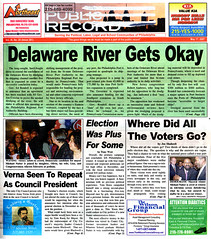
You may or not be aware of the odd local publication called the Public Record, Jimmy Tayoun's rag, which acts as a sort of newsletter-cum-society pages for the city's political insiders (with more coverage for those who pay to advertise there, nearly content-free columns, lots of photos from fundraisers, and other follies) -- it comes as a freebie to elected officials and who knows who else. Well, suprising to none, they were all gung-ho for Brady, full of cheerleading articles and relegation of the other contenders to inner pages. And still I was stunned to see the cover of the issue dated the day after the election (which arrived sometime this week, I think):

May 17 PR cover
(click for a larger version)

Notable here are the following: (1) the top story concerns dredging of the Delaware (obviously the news of the week), (2) there are three stories about the election, but none of them concern the mayoral winner, and (3) they actually come close to not mentioning Nutter's name on the front page at all -- it appears only in the photo captions and in an article about money raised and spent, which notes that the "Knox bloc could endure in city politics if a Nutter administration falters." Eesh.

I understand that this came out the next day, writing deadlines, blah blah. And yet somehow they managed to complain about low voter turnout, speculate about the Council Presidency based on the results (although they could easily have written that in advance, with spin to be filled in later), and talk about Knox's masterful use of money and the respect that it brought him. But that new guy? I guess he's on his own, at least until page 7 . . . (where he gets a grudging congratulations)

[Note that Brady and Evans get a photo spread on page 4 under the header "Congressman Bob Brady Always a Leader." John Perzel is named "2007 Public Servant of the Year" on page 19.]

Labels:

Friday, May 18, 2007

New favorite thing

I was recently waiting for a bus by one of the ordinary glassed-in bus shelters on Walnut, when I noticed that on the outside of the shelter (probably opposite the posted schedules) was a neat new feature that must have come from a collaboration with the city's historical archives: it showed the opposite corner photographed some time in the 1940s, along with a matching photo of the building currently on that corner, and offered some historical chat (who was President and other trivia from the earlier time point, what changes in the neighborhood led to the razing of the old building and the erection of the new stuff, etc.). Will try to get a photo at some point, and will be on the look-out for more of these. Great idea!!

Labels:

Saturday, December 09, 2006

At-Large City Council Forum

As promised, here are my notes from Thursday night's event (sponsored by Neighborhood Networks and held at the Itailian Bistro on Broad Street downtown); I didn't check any names for those who weren't known in advance, and I also should make the disclaimer that my notes were abbreviated and thus may omit some points made or other impressions. But I did fill up both sides of the two sheets of notepad paper shared with me by another audience member, so perhaps there's enough to find of use...

There were a dozen candidates present, and probably 100+ people in the audience -- enough that a number had to stand throughout the event. The candidates were seated in a ring on a raised platform, and the rest of the space had tables with 4 chairs each---a higher ratio of chairs would have helped, but the restaurant staff were busy elsewhere and probably couldn't get through the crowd anyway.

Before the event got underway, there was quite a hob-knobbish scene as people flowed in, some in suits, some more casual; some apparently supporters of some candidate, most there to figure it out; a few reporters (though they may have represented only the Public Record). Among those glimpsed here and there working the crowd for their own ends: [mayoral candidate] Tom Knox, [recent and probably future State Rep. candidate] Larry Farnese, [likely District Council candidate] Vern Anastasio, and [likely District Council candidate] Irv Ackelsburg. Aside from those and some NN Steering Committee folks, however, most of the crowd was new to me. The crowd, like the candidates, were quite diverse in age and race (maybe 60/40 white/black, with a smattering of others). They were quite interactive, applauding some points made by the speakers, giving talk-back to various issues and discussions ("you preach it!" or "don't we know" and so forth), and generally creating a lively atmosphere very attuned to what was being discussed.

Gloria Gilman (NN Chair) gave a brief introduction to the organization and the event, and then John Hogan took over as MC of the forum itself. [It was announced that Jim Kenney was unable to make it due to a prior commitment, but hoped to attend any future such event.] First the candidates would each have 3 minutes to introduce themselves and their aims (going in alphabetical order), and then each would be given a "lightning round" question chosen randomly from a batch of prepared questions (going in seating order). (All of these were, I think, gleaned from the extensive questionnaire that the NN elections committee has prepared for citywide candidates seeking our endorsement; see here.) I'm going to present these two phases as two lists, for simplicity (I hope). First, the introductions -- just some out-takes:
Rev. Jesse Brown (around 50, black, N. Philly)
Touched on the importance of healthcare issues, anti-casino activism, eminent domain, environmentalism, city home rule. Had a good populist cant -- call and response with the crowd, quite dynamic, motivated/-ing.
Maceo Cummings (around 50, black, W. Philly)
A quieter presence than Brown (lost a bit by the contrast), he talked about having spent his life in community service. He spent most of this time telling his resume, which seemed largely financial -- comunity development.
Derek Green (around 40, black, not yet formally declared)
He gave his background, which appeared to be financial and legal. His motivation for entering the race would be to "end the culture of violence" and that's basically all he talked about here -- Blueprint for a Safer Philadelhpia may have been something he was involved with.
Bill Greenlee (50+, white, Fairmont)
Talked about his work in Fairmont, as Councilman David Cohen's chief of staff, as 15th Ward Leader, and his interest in working with all groups who want to make the city better. Talked about the speed entry he's had into Council in the last month, becoming chair of the Law and Government Committee, etc. Said that the challenge of the future would be how to keep government services running in the face of seeming zeal for tax cuts (and said he'd come down on the side of services, if a conflict arose). All good thus far, but then he brought up the issue of having been criticized for how he was s/elected -- this elicited grumbles from the crowd and made him sound defensive -- saying he's as progressive as anybody that the critics would like to see in office. Running long, wrapped up by quick mentions of housing, crime, and transit as top issues.
Elmer Money (45, white, NE Philly)
Not sure who this guy was, but he appeared to feel out of his depth (inexperienced? Republican?). He had a written speech prepared, then filed it away, then kind of went with "there has to be a better way" and "I want to make a difference" and sat down.
David Oh (40-50, Asian, SW Philly)
Background in D.A.'s office, army, legal services center; has served on many impressive Boards and Commissions. He was well-spoken and earnest, talked about the need to build on the city's strengths -- mentioned the Delaware River dredging issue and how it could increase port jobs by 10-fold, the need for improved education, etc.
Blondell Reynolds-Brown (40+, black, incumbent)
Mentioned that she worked her way up from committeewoman, had been a teacher. Said that she was interested in business and the arts, but decided to focus most of her efforst on children. Gave the example of the stadium dispute of a few years back, and how she wrangled a tie-in to benefit kids via a 30-year agreement that the teams would chip into a children's fund that could be given to various nonprofit organizations and programs. She has also sponsored childcare bills, and vows to continue making that issue her focus.
Ben Ramos (50+, Hispanic, N. Philly?)
He gave his educational history (M.S. in Community/Economic Development), worked with the Housing and Development Agency, various other boards. In politics, he was chief of staff for Councilman Angel Ortiz, Deputy Mayor under Rendell, and a State Rep. (!), working on Health and Human Services committee and Urban Affairs. He mentioned that the city is facing some complex issues in coming years, including increasing benefits costs, need for ethical reform, neighborhood development, and tax reduction. He was softspoken and earnest.
Matt Rubin (around 40, white, Northern Liberties)
He was the head of the Northern Liberties Civic Association, and has been an activist on issues including abortion access, HIV, and fair housing. Said his two top issues were education and jobs, but also mentioned overhauling the zoning code, ethics, economic fairness (specifically that we must have growth with justice), and maintaining community diversity (rather than letting gentrification push people out), bridging the ethnic divides that have been used to turn us against each other. Cleary a kindred spirit to NN folks. He had a good exhortative style that got the crowd behind him -- great quote near the end (from some philosopher): "A society of sheep begets a government of wolves."
Marc Stier (around 50, white, Mt.Airy)
Worked with West Mount Airy neighbors, saw "how the system worked," which is that it *doesn't* -- favors the connected. His theme is that "politics in Philadelphia is broken" and that we need to replace the "politics of fear with the politics of hope." Speficially, he talked about overcoming the discriminatory structure of local government (need to know somebody to get anything done), to let ourselves try some policies and programs used successfully in other large cities, etc. Mentioned working on our economic corridors, inclusionary housing, violence, and letting people stay in their homes "during the good times, after they stayed through the bad times." He also has a good style while hitting his high points, got the crowd excited. [Also one of NN's founders, so by definition sympatico.] Ended with a short (anticlimactic) note thanking the other candidates for being willing to "come to my house" (an NN forum) for this event, saying he "looked forward to visiting yours."
Sharif Street (35, black, N. Philly?, dreadlocked)
Talked about his background as a lawyer, involved with affordable housing, drug addiction efforts, the Broad Street empowerment zone. Tried to distance himself from charges of nepotism by talking about parents who were "a hot-dog vendor and a substitute teacher," and that although they've done well, he's making his own way. Emphasis on remembering where you come from...
Andy Toy (35+, Asian, not yet declared)
Working on economic and community development (CDC). Mentioned the importance of the community coming together behind common goals, mentioning the battle to keep a new stadium out of Chinatown a few years back. Also spoke on the need for Philadelphia to promote our assets better, as well as to improve fairness and protect diversity in the city. He was quiet but well-spoken, and it was unenviable to go last after a long line-up.
On the whole, this was a more impressive showing than I had expected. No loons or losers, although clearly some had made more of an impression than others. From there we went pretty directly into the question round (although a portion of the crowd took off). I was happy that some of the people whose introduction had been more resume than policy got into some chewier material in response to their questions -- perhaps all the issues and crowd responses were getting some cross-pollination going.
  • Q: What steps do you think the city can take to increase the amount of material we recycle?
    A: (Stier) There's a great pilot program, Recycle Bank, that has been working like crazy (ties recycling to an economic growth stimulus, saves city money) -- we just need to care enough to put it into practice.

  • Q: Would you repeal, modify, or retain the current system of property tax abatements for new construction?
    A: (Toy) Interesting question. It might be that some parts of the city no longer need that incentive, others perhaps need more. We also need to give some thought to what we'll do with the additional revenue stream as past abatements end -- perhaps an affordable housing fund could be established.

  • Q: There is a shortage of 60,000 housing units for poor people in Philadelphia, and rents are skyrocketing. What do you propose to deal with this situation?
    A: (Rubin) tax abatement $$ could be used to subsidize affordable housing. One neighborhood was able to get such an agreement from a local developer, and the city's leverage is much greater...

  • Q: What changes would you make in how the city and related agencies contract for services? [Actually, I'm not sure whether he was asked that question or "What standards of behavior or operation do you think the city should require from businesses that receive contracts or benefits, such as tax abatements or subsidies, from the city?" Notes too minimal.]
    A: (Green) Talked about a program in Baltimore (CitiStat?) that helps oversee the effectiveness of city services...

  • Q: What steps can the city take to reduce handgun homicides?
    A: (Cummings) Before we can make any policy work, we need people to feel like the government cares, and also need people to feel good about where they live. [Lots of crowd agreement here. He warmed up a lot from the first time.]

  • Q: What role, if any, do you think casino gambling should play in Philadelphia's economic development?
    A: (Greenlee) We have to accept that they're a done deal and make the best of it. Glad Harrisburg left the city in charge of things after all. Need to watch carefully that comunity benefits agreements are honored...

  • Q: How would you exercise the city's leverage over SEPTA to improve its service and performance?
    A: (Street) We should ask that levels of city service match those in the suburbs -- we especially need to improve cleanliness and safety, so people will use more. Should also help SEPTA pressure the state for funding. Made an interesting note that gas tax money goes for highway improvements but not to help with city streets; if we could change that, we'd free up money for doing more with transit locally.

  • Q: What role should local communities have in determining whether and how casinos and other developments are built and operated?
    A: (Money) Neighborhood input is key to any large addition to the region...

  • Q: What measures would you support to protect low-income homeowners from rising property taxes in the wake of gentrification?
    A: (Brown) Don't want to tax people out, may need financial help not only with taxes but with upkeep of their properties.

  • Q: How would you regulate campaign finance in Philadelphia?
    A: (Ramos) The current bill is in the right direction but not enough. Ideally, we need public financing, but at the least we need better disclosure and clarification of how enforcement will proceed.

  • Q: What municipal services in Philadelphia do you think are most in need of improvement?
    A: (Reynolds-Brown) The big problem is that departments and agencies don't talk to one another, so they aren't working as efficiently in delivering services as they should (example of parallel programs for children run in 3-4 different departments with no coordination)...

  • Q: How would you deal with the financial difficulties of the Philadelphia Gas Works?
    A: (Oh) Need a clear way to look at different groups of users... Need more budget overall to help PGW among others -- off onto economic growth ideas, talking about the zoo as a city asset (but that the train doesn't stop there!), leveraging the tech/pharma health sector, bringing more people in by investing in infrastructure, tech. transfer... The crowd got restless over the change of subject, but he did what he could with an issue he clearly didn't know much about. Finally, Hogan ended things with a joke about how it's always the Republicans who run long.
Anyway, a range of chewy chat; I think everybody in the room was pleased and revved. I was happy to see that the majority of this group was intelligent, well-informed, and well-spoken. With a couple of exceptions, I could see any of them doing the job decently. Sharif Street, who gets the most flak, was better than I expected, although hardly wowing. But the folks who made the best overall impression on me were Brown, Oh, Reynolds-Brown, Ramos, Rubin, and Stier; Cummings and Greenlee also seemed reasonble. These are pretty early days, so you can expect all of these people to become better informed and polished, and we can hope that we'll hear more about all of their policy positions and priorities in the next few months. It's also likely that more candidates will emerge from the woodwork, and I'd still like to hear from incumbents Kenney and (Juan) Ramos. But at least we've kick-started the process, and gotten the candidates thinking about issues and voters before they get too wrapped into the political gamesmanship part of the process. The candidates appear to have enjoyed the experience as well, and at least one said he'd be doing some research about the issues raised by the questions. All in all, a great start!

Update:
oh, for those who want to know, there are seven total At-Large seats, of which two are reserved for the minority party (Republicans). Thus, presumably Democratic primary voters will be picking their top five from the final pile...

Update 2: for another perspective on the event, see this report at the Philadelphia Independent Media Center.

Labels: ,

Monday, October 02, 2006

NN conference round-up

pseudologoNeighborhood Networks held it's first Annual Meeting this past Saturday, following on last summer's founding conference. It was another great success, and both enjoyable and informative. There was some motivational revving up of the troops, but the majority of the meeting was spent in getting down to practicalities:
  1. there were skills workshop sessions on topics like canvassing, lobbying, and issues research
  2. there were also issues sessions updating participants on the state of the fight on healthcare, affordable housing, etc.
Great presenters, with many tales from the field, practical tips, and generally lots of information to absorb. Also time for some interesting discussion with presenters, and gatherings with others from one's own neighborhood (although I had to duck out before the end). I hope it will put people in a better position to get aboard with various efforts already underway and to spearhead new work in other areas. Very glad I was there, even if it fell in the midst of an already busy electoral season.

[Missed the meeting, but want to plug in? Visit the new NN website to locate your neighborhood coordinator and especially to look into the action committees, all of which could use your help; lots of specific contacts are listed here.]

Labels:

Thursday, July 20, 2006

One man's wackiness...

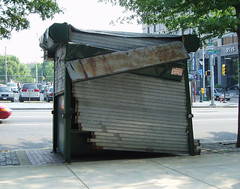
When I heard the story this spring about the guy who tried to start a newsstand business by stealing and relocating a bunch of kiosks all around the city, I thought it was pretty amusing and wacky. However, when this one was returned to the sidewalk out front of my place of work, I got a different feeling:

damaged newsstand

Suddenly, all I could think about was the lost livelihoods represented here, both that of the owner (was he insured? or did he lose everything?) and the person who once worked inside.

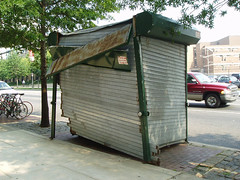
damaged newsstand, from side

It was like seeing a battered veteran sitting out on the sidewalk week after week, and suddenly the cranes-by-night scheme didn't seem so funny anymore.

Took me a while to get around to shooting this (last week), and I was lucky I did it then, because by the end of the same day the newsstand was gone. I hope my camera didn't make somebody nervous; I hope there's an insurance settlement in somebody's future, and maybe a new newsstand to serve the gum and tobacco needs of this corner . . .

(p.s.) Advance warning: I've bookmarked a bunch of news links for the day, but won't be able to blog them until this evening. See you around 8!

Labels:

Friday, June 23, 2006

First impressions

Had the opportunity to meet one of Philadelphia's mayoral hopefuls this week, Tom Knox, at a gathering of interested young (cough) folks. Was interesting to see him in person and hear him talk about a range of issues that he'd been studying over recent months. In no particular order, here were some of my takes:
  • He was naturally wonky -- loves numbers, thinking about the details of city government as a business, where money could be saved or shaved through better management, etc. It was impressive in the He Knows Shit way, but I think tended to make his audience glaze over more than get passionate. Quite happy to talk about the taxes, especially eliminating the gross receipts portion of the BPT, but realistic about the fact that savings elsewhere would have to be found first. However, he also talke about improving city services, so it's not all tax-cutting...

  • He had some interesting ideas about broadening educational opportunities in the city, including reopening some "Vox-ed" schools that used to exist, to give students incentives to stay with their education (to get some training as, say, mechanics or hair-dressers). Additionally, and more boldly, he had a plan to help lure new businesses to the area by launching a series of training centers all over the city to help guarantee that skilled labor would be available to fulfill their needs -- something like offering a year's ramp-up training (to sales, drivers, clerks, whatever was needed), fully financed, with the promise of at least one year's employment on the other end. (You build the factory, and we'll have a workforce for you by the time it's ready to open.) Neat to see some long-term thinking, although it could be hard to swing.

  • Interesting mannerisms/feel. He's soft-spoken and less of a glad-hander than, say, Nutter or Saidel, but plenty confident and clearly intelligent. On the other hand, he spent probably 90% of the evening speaking directly to me (even if answering somebody else's question), as though the other dozen people weren't even in the room, which I thought was pretty bad manners, let alone politicking. It made me feel genuinely uncomfortable (not personally, but socially, if that makes any sense). Additionally, his talk about racial issues tended to the slightly quaint (somewhere between patronizing and cliched), although he had reasonable information at his fingertips too (e.g., about black voters' interest in capability over race). It's hard not to hold these things against a candidate, although (a) they could be gone in another month or two of campaigning and (b) they could have little effect on his ability to run city government or interact with employees. Still...
That's about all for now. I hope to get chances to meet or at least see appearances of all of the candidates by the time this primary is really underway, say next fall. Thanks to Tulin for the invitation; I hope she gets her technical difficulties solved so that she can share her impressions as well (if so inclined).

Updates:
  1. Here's the Knox campaign site, which I should have linked above.

  2. I realized there was another thing that took me aback a bit: Knox appeared to applaud the effects of gentrification. Yes, he made some disclaimers along the lines that seniors or the medically disabled should be buffered from increases in property taxes that might displace them, but pretty much the poor were given little sympathy. Heck! they could cash out! Have family in the area or other community attachments? Too bad; sell your house and learn to love a less popular neighborhood. Long-term renter being pushed out by the sudden doubling and tripling of city rents? That's the price we pay for increased city prosperity; you can stop by anytime and enjoy the new streetlights! (yes, it made me feel snarky.)

Labels:

Sunday, April 09, 2006

First Democratic Senate debate

Yesterday was the first public debate between the three Democratic contenders for the nomination for U.S. Senate -- Robert Casey (Jr.), Chuck Pennacchio, and Alan Sandals. It was rebroadcast this afternoon, when I managed to catch it on local public cable. On the whole I thought it was a well-run debate, and that the three contenders acquitted themselves well, which is good for the voters and the party.

My two major impressions were the following:
  1. This is the second time that I have seen Pennacchio and Sandals. Their views on many issues are quite similar---they're both progressives---but their styles and emphases differ. In both cases I was more impressed with Sandals, and he is my choice in the primary. (I know that this will disappoint the fervent Pennacchio supporters, and I know that the latter may have a head-start on organization-building, but because I think that both of these men are long-shots in the primary, I prefer to vote my simple personal preference, rather than agonizing over strategic considerations for the long haul.)

  2. This is the first chance that I've had to see Bob Casey in action. (I did see one previous TV interview, but it dated from around the time of his last election and didn't touch on the hotter issues of the current race.) I was favorably impressed. He's not a spit-fire, nor, as we already knew, is he as progressive as the other primary contenders. However, I found him well-prepared and well-spoken, and he did support many issues on which Democrats agree (and differ from current national leadership). I was most impressed, however, with how he handled the hot-button issue of choice---he couldn't claim to be anything other than pro-life, of course, but he made clear the many ways in which his views on the issue differ from those of Sen. Santorum (such as support for birth control and sex education), and he also expressed the hope that difficult topics could be discussed, not just warred over, and that central ground could be found in many cases. Yes, I would prefer that all the candidates be more proactive about a woman's right to control the fate of her body, but I was pleased to see that Casey was prepared to handle criticism of his position, and that he had plenty of ammunition for ways in which his holding the office would improve the lives of Pennsylvanians. It made me feel better about the prospect that I might find myself working to support him in the fall...
That's all for now. Let me give the caveat that these are just my overall impressions (noted several hours after watching), and it's entirely possible that I would note different things if reviewing the transcript. Also, there's one more debate planned for April 19, if you want to get a look for yourselves.

Update: Above Average Jane also reports her impressions, and Fact-esque actually did live-blogging coverage of the debate, with questions asked and many of the points made (whew!).

Labels:

Tuesday, March 28, 2006

A tale of two meet-ups

Barely managed a double-header of political events this evening, one a Young Professionals gathering/fundraiser for Patrick Murphy (running for the US House, 8th District) and one for Anne Dicker (running for the state Assembly, 175th). Both are candidates who have generated a lot of excitement locally, and I hadn't met either, so was looking forward to putting some faces to names and stories. Murphy's race is quite high-profile nationally and has been underway for a number of months, while Dicker is prominent only among progressive activists and jumped into the race only a few weeks ago, when a seat became open at the last minute. Thus the campaigns are at pretty different scales and stages, and the events were necessarily something of a contrast. Anyway, my impressions of each.

The Murphy event (at a bar a few blocks north of Rittenhouse Square) was a bit of a Who's Who of local pols, with State Reps. Babette Josephs and Michael Gerber (another young rising star) giving introductions, fellow candidates Paul Lang (state Senate, Bucks) and Bryan Lentz (state Assembly, 161st) in attendance [all part of the alliance of veterans running for Democratic positions], and City Councilman Michael Nutter stopping by briefly to shake a few hands at the margins (before heading to an event of his own). Murphy himself was nice, direct and real, and gave a good speech that talked about things that needed changing in Washington and some specific things he'd like to focus on (from cutting the deficit to getting the government to buy medicines in bulk for public health purposes). His staff also impressed me -- for example, I spoke to a financial guy who was interested in getting Patrick to develop an online presence, but who demonstrated a meaningful understanding of the need to do it right or not do it at all (i.e., that a token blog brings only wrath from readers, rather than engaging possible supporters). In net, I was already a Murphy booster, because Patrick is a progressive running against a Republican yes-man, but now I can back my support with first-hand experience that he's also an earnest guy who's on top of his game. It also sounds like they may be announcing a big number for 1st-quarter fundraising, so the race is plenty live...

The Dicker gathering was in a bookstore just off of South Street. Having hustled across town, I got there about an hour after it started, and missed the formal talk (if there was one; a videographer might be planning to share the proceedings), although Dicker was fielding questions when I arrived. She seemed confident and enthusiastic, and was encouraging people to volunteer their time to go door-to-door and talk about her candidacy. I came in pretty certain that she would advocate the "right" viewpoints on various issues, based on the positions taken by Philly for Change, the Dean-for-America affiliate that she helped found and lead. However, I was a bit surprised that she wasn't a bit more on top of relevant local facts; for example, she was advocating taking action on the minimum wage to Senate President Jubelirer's home district/constiuents, but then she didn't know where his home base actually is (Altoona), and she was passionate on the need for controlling gun violence, but expressed a lack of familiarity with the bills currently under discussion at the state level. I grant that she's had to go from 0 to 60 in very short order, and that the focus of her efforts right now is probably on recruiting street troops and some donations to cover flyers and the like, but I feel like some knowledge of the issues should come just from being a political junkie, let alone a candidate. It's easier for many folks to rant about things that happen at the national level (and there's plenty that needs fixin') than to focus on the issues and measures that can be controlled more locally, and I guess I would have liked to see more mastery of the practicalities. On the other hand, I haven't seen other new candidates for state office "perform," so I don't know what the standard really is for polish and knowledge going in. Certainly, having a better grasp of the machine function but less ideology driving your candidacy is hardly a recommendation. Perhaps I'll have a stronger opinion after sizing up Terry Graboyes in coming weeks (unsure whether O'Brian will be reaching out my way, given likely party support).

I'd like to have a stronger opinion in this race than I currently do (even though it's not my district), especially with a progressive activist in the race, but I'm still collecting information (e.g., see the NN post from earlier today) and just feel that I don't know enough to commit my own energies yet. Perhaps this is what scares so many people away from primaries, where the policy differences aren't always so sharply defined nor the candidates so visible, leaving voters feeling unqualified to decide the party's fate. And yet here, where the primary is the race, we can't afford to stay on the sidelines. I hope to be in the game soon, and you'll be sure to hear more then.

[Updated with campaign/info links, 3/30/06]

Labels:

Saturday, February 04, 2006

Unexpected opportunity

Thought we had house-guests for the weekend, so hadn't made any plans -- when the guests got sick, I was sorry to miss them but happy to be able to take advantage of an invitation to be a blogger member of the press at an event today sponsored by the American Democracy Institute, an obscure but earnest year-old organization focused on getting young people involved in civic life (or at least, that's the impression I got from this event, although their website talks a bit more vaguely about civic discourse and fundamental principles of democracy). It was a big convention of students and other young folk from the Philadelphia area, going to panels and workshops on voting rights, the relevance of the Constitution, faith and politics, empowering youth, and the role of the media. But the thing that made me willing to give up a much-needed morning to sleep in was that Hillary Clinton, the organization's honorary chair, was giving the keynote plenary talk. I thought it would be interesting to hear her speak in person, as well as to see what it was like to be part of the press at a high-visibility event.

Bloggers appear to inhabit a nether realm of event organizers’ awareness -- they want you there, but they only half consider you "real" press. None of us got credentials (although I did get a press pack, which reproduced many of the website blurbs, but didn’t offer, say, any of the names of the presenters), so I had to be walked up the stairs by the woman in charge of things, who smoothly got me through the three checkpoints and into the zone set up for bloggers (with stubby ethernet cables in case we wanted to live-blog in a tight circle). Actually, our position was great -- we were along one side of the room, even with the front rows of seats, and thus about 20 yards from the podium. I was there with Albert "dragonball" Yee, Tulin of PoliticsPhilly, the Booman, and a woman Robin who blogs at Factesque. Duncan Black (or Atrios) was also there, but had an official reserved seat since he was part of the Media panel... In fact, much of the first 5-6 rows was reserved seating, with local bigwigs, conference participants, and a section for student press. There was also a raised platform for press video cameras, and a constellation of other camera-wielders, professional and amateur, flitting like insects around a porch light, working the shots and angles (Albert was among these; I’m counting on him for the photos I didn’t take).

The plenary session began with a disembodied voice calling for folks to sit down and announcing a requirement for civil discourse. Then there was a moment of silence (I missed what we were commemorating, but I suspect it was war-related) and then two students led us in the Pledge of Allegiance (? !!). Then some guy (press pack, anyone? or even a program for the bloggers to share?) gave a short introduction on the need for involvement in public life and then introduced the first of the official speakers. There were two of these "warm-up" speeches, and I’m not really clear how they were selected. The first guy gave a rather professorial speech (and I think might have been a Princeton professor) of a historical nature – invoking the great historical documents signed nearby, and pointing out that the principles of democracy have always been a challenge and required defense (he pointed out a period in the 18th century when dissent was briefly outlawed). He concluded with the argument that it’s not might that makes right but "right makes might." It was probably a decent talk, but a snoozer in the context; the student press wasn’t even looking his way, for the most part, peering into the hallway where organizers and Secret Service guys were milling around...

The second speaker was the president of The College of William and Mary (I guess I could look up his name, but I’m still annoyed about the press kit). He made a joke about feeling "like a garage band opening for the Rolling Stones (although Hillary Clinton is much younger than the Rolling Stones)." heh. In fact, this guy turned out to be quite an enjoyable speaker, with a good natural cadence, a mix of jarring statistics with inspiring quotes, and a little humor along the way. High points:
  • In talking about the ill effects of pay-to-play culture on our society, he quoted Barney Frank as having said that we’re the only country in the world that imagines that "our politicians walk up to complete strangers, beg them for thousands or hundreds of thousands of dollars, and then walk away completely unaffected (thus achieving a perfect state of ingratitude)." heh.
  • He talked about other things that create disparities (or undermine equality) in our nation, from gerrymandering, to attempts to eliminate judicial review, to poverty. A striking statistic that he quoted for that last issue was that children from families who earn over $90k per year have a 1/2 likelihood of becoming college graduates; for families earning under $35k per year, the figure is 1/17...
  • The general theme of the talk was really "What is the American idea of equality?" and he suggested that the disparaties that we see in our country are not what the Constitution, scripture, or our ideals envision. Quoting Lyndon Johnson, he said "we may not know much, but we know the difference between chicken salad and chicken shit."
He ended with a veritable war-chant litany of inspiring quotes from a wide range of (unattributed but often obvious) sources, some references to Dr. King, and a standing ovation from the crowd.

Then it was time for the Main Event. A student from Community College of Philadelphia (and head of some Latino youth organization) gave a brief introduction, and then Hillary Clinton came out from a backstage door, to thunderous applause. She looked chic but casual, but the thing that struck me, given the range of people at the mic before her and the excellent sound system, was how shouty her voice sounded -- not hoarse, but as though she had developed an Official Oration Voice that involved deepening and projecting to a somewhat unnatural degree. She was almost too loud in this well-amplified setting. Other than that, she seemed smooth and natural, rarely looked at her notes, and was generally a better speaker than I expected from the few clips I've seen on TV. However, she was hardly the Rolling Stones compared to the guy that preceded her, and it felt more like a campaign speech listing things that need to be changed than it did an inspiration to interested youth about ways they could get into the game. Perhaps that's par for the course. (I noticed to my surprise that many of the video cameras left a few minutes into her speech, implying that they just needed some visual for the 12:00 news, rather than a full transcript for clips.) Here are the notes I made:
  • She got people to stand up to show their involvement; first public servants, then community organizers, then poll watchers and voters -- look! you’re already not apathetic youth! Of course, the crowd (especially down front) wasn't all students, but ok.
  • She looked back at the many changes made through history to expand freedom in this country, not least to women and minorities.
  • She listed a lot of issues still needing work, and called them "unfinished business for American democracy." (I’m starting to see the theme of the meeting, and have retro-bolded accordingly.)
  • She gave examples of specific things that youth groups have done to have a national impact from "girlcotts" against sexism to student journalism (MTV reports on Dafur) that kept the mainstream media honest.
  • She mentioned a flurry of voting-rights issues, ranging from the need of students to vote near their campuses to national voting reform "so that all votes are counted and every vote counts." As part of this she mentioned that the youth vote increased more than any other group between 2000 and 2004. I’m pretty sure I remember seeing this debunked (that is, more youths voted, but more of everybody voted, and the % stayed the same), but it could be a difference between the brackets used: she cited something like 18-25-year-olds, whereas the other research might have been specific to college students. Not sure.
  • Finally, she talked about the need to fight the degradation of debate (yelling fests on TV) and the tendency to avoidance of facts (which served as a lead-in to discussion of global warming and the need for alternative energy sources).
She ended on the call for a broad-based progressive movement, sadly invoking the tired analogy of an Iraqi unit in saying that we should all work together. The crowd gave her a wild send-off, but I just kept thinking, Bring back the previous guy! While I didn’t disagree with anything here, it just left me a bit Eh.

Anyway, that was it for the big show. There was a pretty substantial break before any of the afternoon workshop sessions would resume, so I just had a look at the tables in the lobby -- Planned Parenthood, Habitat for Humanity, Association of Young Americans (? trying to give a greater voice to the 18-35 group), Save the Environment, Women’s Campaign Internation, Young Involved Philadelphia, Americorps, Aspira (? an education/leadership group for Puerto Rican and Latino youth), and the Young Democrats -- and then headed out. A little blogging and then maybe some sleep? I’ll link to Albert's photos of the actual proceedings as soon as he puts them into the net . . . Special thanks to Tulin, who live-blogged the whole thing!, for putting in the names of the rest of us (to the organizers)! glad to have been there.

Update 1: Robin's account covers the whole conference. I agree with her that the clearly missing piece was the way to get from Things Needing Fixing to Where You Can Get Involved. Kids, especially, have no idea of how they can get active and really make a difference (other than, say, running for office or becoming Young Democrat feebs)...Hillary, taken by Albert

Update 2: The Inquirer's description of the event is here.

Update 3: Albert's fantastic visual overview of the event (and look! speaker names!) is now available online. Wonderful, as ever, for the artistic eye as much as for the subjects themselves... He also subsequently blogged the photos with his verbal summary of the event, in three parts: 1, 2, 3.

Labels: